

The Mackintosh Kitchen Range: A Closer Look at Ebstone’s British Handmade Kitchens
There is a specific kind of kitchen that a German engineered range, for all its precision and performance, will never quite deliver. It is the kind you find in a West London Victorian house where the original architectural details have been carefully preserved, or in a farmhouse conversion where the design needs to feel as though it has always been there. This is where our Mackintosh range comes into its own.
The Mackintosh is Ebstone’s British handmade kitchen range, produced by skilled craftspeople and specified entirely to suit each individual project. It is available in our Ealing showroom alongside our German Nolte range, and the contrast between the two tells you something useful about how different they are in feel and character.

What British Handmade Means in Practice
The term handmade is used loosely in the kitchen industry, and it is worth being precise about what it means for the Mackintosh range. These are kitchens where the cabinet carcasses are made from solid timber or high-quality birch ply, the doors are hand-finished to a high standard, and the overall construction prioritises longevity and craftsmanship over the efficiencies of mass production.
The practical benefit of this approach is that everything is made to measure rather than to a standard module. If your kitchen has an awkward alcove, a chimney breast to work around, or proportions that do not fit neatly into 600mm cabinet increments, a handmade kitchen solves these challenges in a way that a modular system cannot. The result is a kitchen that genuinely fits its space rather than one that has been accommodated into it.
Styles Within the Mackintosh Range
The Mackintosh range encompasses a wide variety of styles, from classic in-frame shaker designs to more contemporary frameless cabinetry with a painted finish. The unifying thread is a commitment to craftsmanship and detail that is consistent across every style within the range.
In-frame construction, where the door sits within a solid frame rather than overlapping a carcass, is a hallmark of the highest-quality British kitchen tradition. It creates a more furniture-like appearance than frameless cabinets and is particularly well suited to period properties. The Mackintosh in-frame options carry this quality through consistently.
Painted finishes are a particular strength of the range. Rather than being limited to a set palette of factory-applied lacquers, handmade kitchens can be painted in virtually any colour, including bespoke matches to existing elements in your home. This level of flexibility is genuinely useful when designing a kitchen that needs to connect with a wider interior scheme.
You can browse examples of completed Mackintosh kitchens in our British kitchens gallery.

How the Mackintosh Range Works With Period Properties
The West London areas we work across, including Chiswick, Kensington, Fulham, and Richmond, have a large proportion of Victorian and Edwardian housing stock. These properties have a particular architectural language: cornicing, sash windows, original timber floors, and the proportions of rooms designed in an era of considered craftsmanship. A kitchen in one of these homes has to earn its place.
The Mackintosh range does this naturally. The shaker door profiles, the painted finishes, the solid construction, and the furniture-like detailing all speak the same language as the surrounding architecture. A well-designed Mackintosh kitchen in a Victorian house feels as though it has been there for decades, which is exactly the intention.
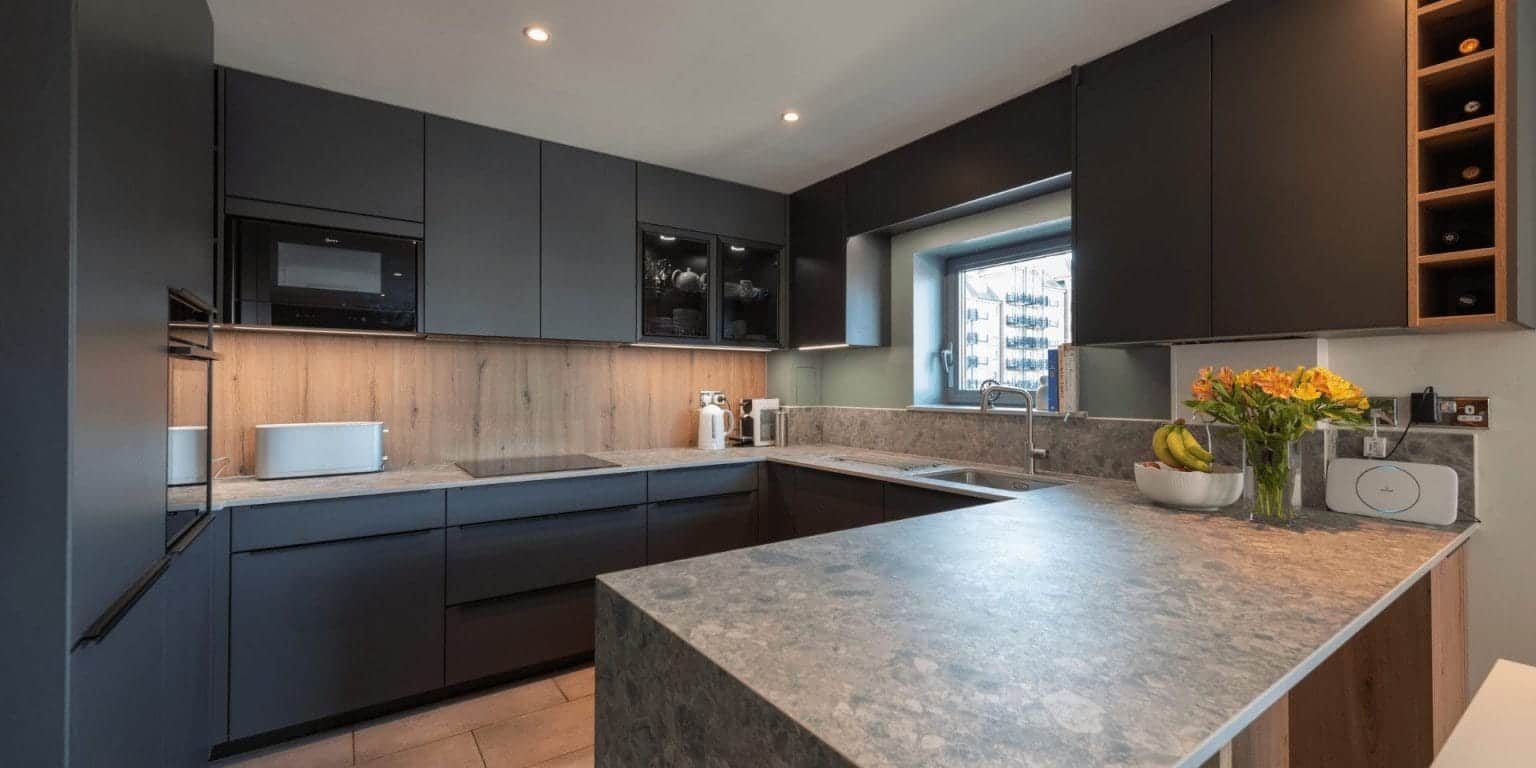
This does not mean the range is limited to traditional designs. Many of our clients in period homes choose a more contemporary interpretation of the Mackintosh: handleless doors in a soft painted finish, natural stone worktops, and integrated appliances that create a clean, modern feel within a period shell. The range accommodates both approaches with equal conviction.
Mackintosh and Nolte: Understanding the Choice
We are frequently asked how to choose between the Mackintosh and Nolte ranges, and it is a genuinely interesting question because both are excellent in different ways. The British vs German kitchens comparison we have covered elsewhere goes into this in detail, but the short version is as follows.
The Nolte range offers precision engineering, a vast choice of finishes including high-gloss and wood effect laminates, and an extremely efficient production process that delivers consistent quality at scale. It excels in contemporary and transitional designs, particularly in open-plan spaces where clean lines and large uninterrupted surface areas are priorities.
The Mackintosh range offers something different: the warmth and individuality of a handmade product, a deeper connection to British craft tradition, and a flexibility in specification that suits irregular spaces and period properties particularly well. Many clients who see both in the showroom find they respond instinctively to one or the other, which is usually a good guide.

Appliances in a Mackintosh Kitchen
The Mackintosh range pairs well with the full selection of appliances we supply. As NEFF MasterPartners, we specify NEFF appliances regularly in Mackintosh kitchens: the contrast between handmade cabinetry and precisely engineered appliances works very well, particularly in shaker-style designs. Miele is also a popular choice, particularly for clients who want the most durable appliance specification alongside a long-lasting kitchen.
Quooker taps, integrated wine cooling, and Elica extraction all integrate naturally into the Mackintosh range. The design flexibility of a handmade kitchen means there are fewer constraints around how appliances are positioned and housed than with a modular system.
To see the Mackintosh range in person alongside our full appliance selection, arrange a visit to our Ealing showroom. It is by far the best way to understand what makes this range distinctive.

────────────────────────────────────────────────────────────
FREQUENTLY ASKED QUESTIONS
────────────────────────────────────────────────────────────
Is the Mackintosh range more expensive than German kitchens?
Not necessarily. The cost of a Mackintosh kitchen depends on the specification, size, and complexity of the project in exactly the same way as a German kitchen. At equivalent specifications, handmade British kitchens can be comparable in price to high-quality German alternatives. We will give you a transparent quotation for both if you want to compare. Our pricing guide sets out the broad investment levels.
Can the Mackintosh range be made in any colour?
Yes. One of the significant advantages of a handmade painted kitchen is the almost unlimited colour choice. We can match to Farrow and Ball, Little Greene, Paint and Paper Library, or virtually any other paint reference, as well as to colours used elsewhere in your home. The finish is applied by skilled painters rather than factory lacquer, which gives a depth of colour that many clients prefer.
How long does a Mackintosh kitchen take to manufacture?
Lead times for handmade kitchens are typically slightly longer than for manufactured German ranges, reflecting the production process. As a guide, allow ten to sixteen weeks from order to delivery, though this varies with current production schedules. Your project manager will confirm the timeline once your design is finalised.
Is the Mackintosh range suitable for a contemporary kitchen design?
Yes. While the range is often associated with traditional and period-style kitchens, it is equally capable of delivering a clean, contemporary aesthetic. Handleless designs, flat or simple profile doors, and neutral painted finishes can create a very current look within the Mackintosh range. Our showroom has examples of both traditional and contemporary Mackintosh designs.
Can I see the Mackintosh range before committing?
Yes, and we would always encourage this. The Mackintosh range is on display in our Ealing showroom, where you can see the construction quality, feel the door profiles, and understand the finish options in a way that photographs simply cannot convey. Arrange a visit and we will show you the full range alongside completed project photography.